
Saat by Emtidi (1972)
A deep-dive into Emtidi’s cosmic folk masterpiece

It won’t be easy for me to write objectively about Saat by the duo Emtidi, because this album is deeply important to me. So please treat this review as a subjective account from an author returning from UDFy-38135539 through earthly spacetime.
Unfasten your restrictive seatbelts and prepare for a soft landing in the folk universe of hippie utopia.
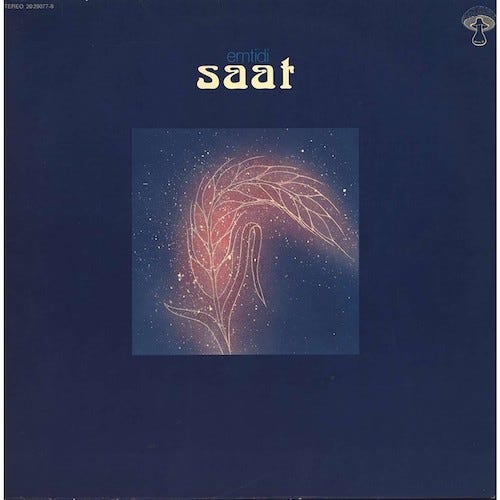
If someone wanted to define “cosmic folk,” I think they would easily find that definition in the grooves of Saat. Even Helmut Fritz’s artwork, depicting a galactic ear of stars, announces what lies inside the fold-out cover.
The record was released by the legendary Pilz label. On bass, percussion, and as Mellotron assistant, we hear the equally legendary Dieter Dierks, who also mixed the material, while the producer is the father of kosmische musik, master of the Cosmic Jokers, and self-proclaimed guru of German LSD culture: Rolf-Ulrich Kaiser.
Yet above all, the album features acoustic guitars (including 12-string), electric guitar, flute, synthesizers, Leslie, vibraphone (phew…), and Maik Hirschfeldt’s various percussion instruments, as well as Dolly Holmes’ organ, electric piano, mellotron, spinet, and piano. And, of course, the vocals of both.
Saat begins somewhat deceptively, with the delicate “Walking in the Park,” almost pop-like. Dolly Holmes leads a beautiful melody over an acoustic background polished like the web of a cosmic spider.
Later Maik Hirschfeldt joins her, and together they declare: “there is a sign here, keep off / don’t sit on the grass, it’s too cold for your ass”, which recalls hippie gatherings in the parks of the Summer of Love, but also, for me, teenage times when the meeting point for oddballs was a patch of grass and the fountain opposite the Grand Theatre in Poznań. Then the rest of the instruments appear, phasing, and a guitar solo pleasantly evokes Krieger or Santana. When the bass begins its march, we instantly achieve satori and “flow” into the album.
The next track is the short “Träume,” where slowly, slowly it becomes decidedly more kosmische. It is truly a wonderful song without a single word, which has always reminded me of the first dawn on a new planet, just after landing.
Three suns rise, purple clouds wrap around giant mountain ranges, a moon encircled by rings looms in the distance, and toward us strides an androgynous siren accompanied by a muscular grasshopper.
OK, time to put down the green tea, because I hear a Jew’s harp, and that’s a sign I’m still on Earth. Hence my association with exotica or space age pop, and Dolly Holmes’ siren voice I could happily hear every morning instead of an alarm clock.
The jokes end when we touch the Sun. The intro to “Touch the Sun” could easily be mistaken for the work of some anonymous Tangerine Dream competitors, somewhere around Alpha Centauri. Similar textures, spiritual-cosmic (how many more times will I write “cosmic”!) vibrations from a newly born or explored world—like “Sunrise in the Third System,” only more melodic, as if this galaxy, solar system, or planet were civilized, in contrast to TD’s wild, pre-human, or pre-alien visions.
Then we return to acid folk of the highest order, led by male/female vocals, from which piano emerges, and a classical, very “imperial” (Kaiser?) sounding fragment—perhaps a recording from the ball of the self-proclaimed Sun King. And here words fail me, because in “Touch the Sun” as much happens as in an entire human life, from birth to death.
“Love Time Rain,” on the other hand, sounds like a fugitive from Magna Carta’s Lord of the Ages or Songs from Wasties Orchard—assuming, of course, that it’s sung by a medieval lady of liberation. Dolly’s luck was being born a little later, because for such feats as here she would surely have been burned at the stake.
In any utopian hippie world, this track would be a hit. If I ran Radio Cosmos, this song would never leave the airwaves until the entire visible Universe was infected by it, and fans of contemporary earthly pop would grow long hair and beards, buy bell-bottoms, floral shirts, and Paradieswärts Düül like the possessed. Not because it was fashionable, but because they would feel it deep in their souls.
Finally, we have my two favorite tracks: the title piece Saat, which I’ll sum up with a lyric: “Time has come, time has come, sowing seeds one by one.” Listening privately, I recall the times when, sitting by the Grand Theatre, I discovered Hawkwind, Amon Düül II, Emtidi, Sand… scribbling psychedelic visions in my notebook and sketching covers of non-existent krautrock bands, gathering metaphorical seeds.
Eventually, I began writing poems, writing and performing music, and writing about it. The sowing continues. Thanks to seeds like this album and to these people who once took me on a lysergic journey beyond the gates of the Universe.
Yes, the Journey. Die Reise. Where before my eyes the history of the world unfolds, and it’s time to end the review.
Objectively, there are equally good acid folk albums, better kosmische musik, and definitely better psychedelic ones—but you won’t find this particular combination anywhere else. Quite seriously, this is one of those records that makes me grateful to have been born here and now, because I can experience it.
Highly recommended!
This review was written by A.J. Kaufmann, a poet and musician from Poznań, Poland. His work spans psychedelic folk, experimental rock, and kraut-influenced songwriting. Albums like Stoned Gypsy Wanderer, Second Hand Man, and TN-237m chart a restless, exploratory sound shaped by underground traditions and European counterculture.
You can find A.J. Kaufmann’s music on Bandcamp here, and you can also check out his other writings on his blog here.
 | A guest post by
|