
A Conversation With More Experience
Inside the acid-soaked dreamworld of Polish psychedelia

More Experience have always existed slightly out of time.
Formed in Poland and shaped by a hunger for the cosmic, the Lublin-based collective built its own private universe far from the Western psychedelic canon. It’s one where Hendrix, Niemen, Gong, and underground student-club freak-outs all blur into a single, strange continuum.
Their 1990s landmark From Acid Dreams captured that moment in raw, unfiltered form, and decades later, its newly restored sound reveals just how visionary the project really was. In this wide-ranging conversation with A.J. Kaufmann, founder Piotr looks back on the band’s origins, the lost possibilities of Polish psychedelia, and much more.
Interview with More Experience
A.J. Kaufmann: Hi Piotr, what’s happening in the world of More Experience?
Piotr: Hello there. It’s hard to answer a question about an entire world, although the question itself contains the essence of the matter. More Experience is a world, a bit like in a novel or a film. As a reader or viewer travels through the story and experiences different events, so when you travel through the world of More Experience, you encounter various phenomena, intuitions, visions, and atmospheres. What kind? That depends entirely on you — who and where you are when you decide to take part in this adventure. Sometimes it’s a magical, oriental journey, and sometimes it’s simply a pretty wild trip.
A.J.: The album From Acid Dreams is already a classic of Polish psychedelia. What memories do you associate with that album and with the 1990s?
Piotr: It was a very cool, pioneering adventure. Shortly before that, we had won a big music festival, where the main prize was several cartons of cigarettes. The studio looked like something from the early 60s: a single-track tape machine, live recordings with the whole band at once, tube microphones. We worked mostly at night, taking turns recording and smoking those prize cigarettes. The whole material was created in a very short time, and for all those years it never received a proper professional mastering. Only recently, I returned to those recordings and did what needed to be done. Now the album — the way it should be — is available on our Bandcamp page. Fortunately, I no longer smoke.
The 90s in Poland were a very interesting period. After decades of communism, everything was new. Young people absorbed every cultural event (literally every one!). Crowds came to concerts, no matter what kind. In Lublin, there were three active bands: a punk band, a blues-funk band, and us — hippie psychedelia. Every show had a full house. There were no computers or phones, so if young people wanted to talk, they had to meet in person. That encouraged imagination and experimentation, also musical. Interesting artistic projects appeared (and disappeared) constantly, and sometimes something truly creative came out of them. More Experience played many concerts back then, which were a kind of spectacle — theatre, visuals, lights, and music all mixed together on stage. At that time, such events found many interested and often delighted audiences.
A.J.: How did the band take shape? Did many musicians come and go, or was it always centered around one “nucleus”?
Piotr: The band was formed in the late 80s. It was an idea of mine and my friend Hubert, our longtime bassist. Shortly after, another Hubert joined us — the drummer. For a very long time, rehearsals took place in my room, using home audio equipment and bits of furniture. That’s how the material was created, the same material we later played at concerts. When the number of concerts grew, bassist Hubert had to quit, and he was replaced by Krzych, who played on From Acid Dreams. Later, Krzych was replaced by the phenomenal bassist Marcin. And then the 90s ended, techno and rap took over, and that kind of music stopped being interesting to young people.
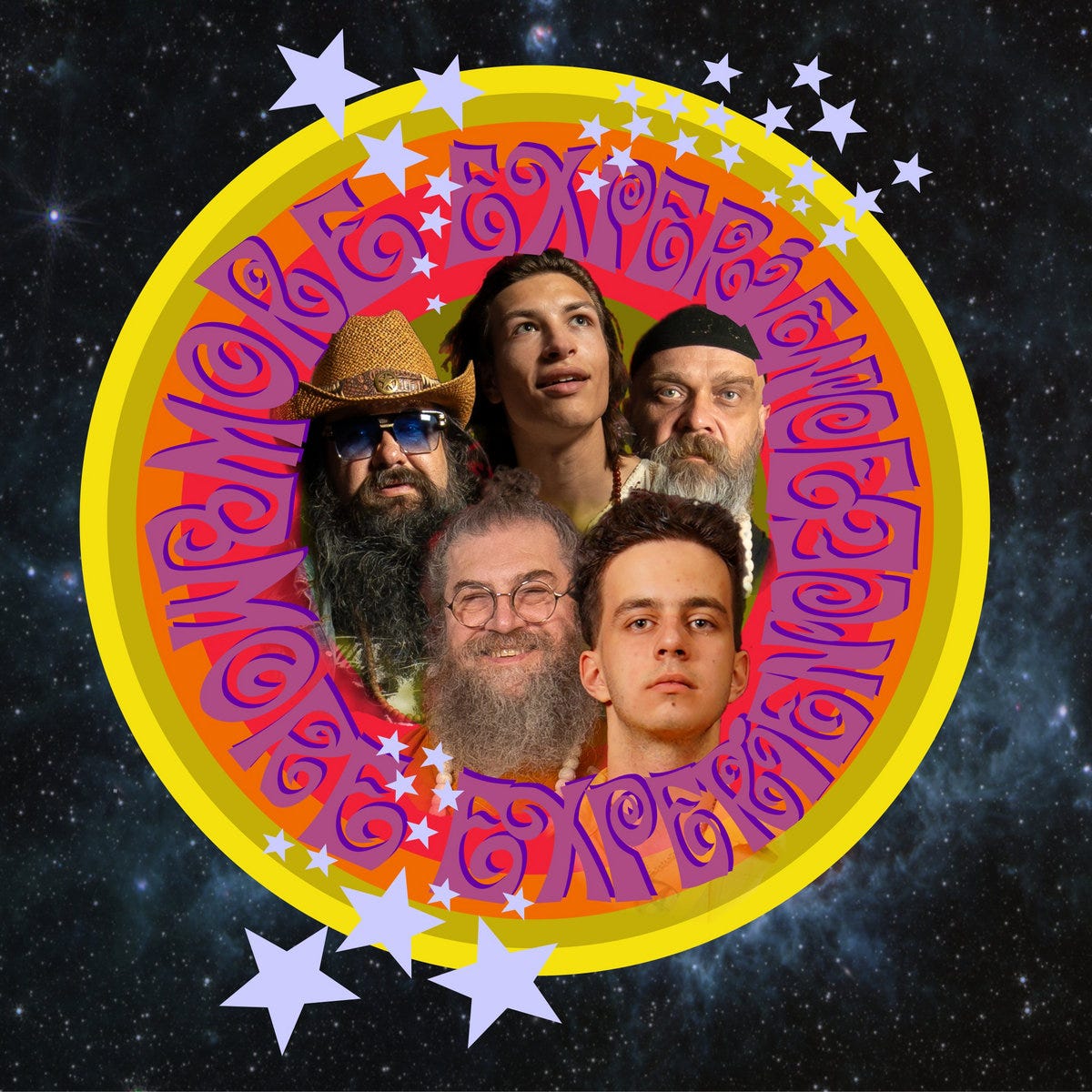
Today More Experience is a band that meets in the intimate setting of a private recording studio, with an excellent lineup of friends. And we simply enjoy spending time together, making music, and experimenting with interesting instruments. Every three years or so, a new album pops out. I have always been — and still am — the spirit of this project. Today I play with my son Janek (Jassmine), an extremely talented drummer and student of Jazz and Popular Music at UMCS in Lublin, and with Filip (Feel U), a drummer with incredible feel, studying at the Academy of Music in Bydgoszcz. On bass we have Marcin (mr Undertaker) — a veteran of jazz-rock power — and Eryk (Mahasadhu ErPa), a guitarist and vocalist with extraordinary power and unusual skills (for example, he’s great at Mongolian overtone singing, choomei).
A.J.: Tell us a bit about your inspirations — the old ones and the current ones.
Piotr: The answer to that question is the music of More Experience. I think everything can be heard there. The 60s and 70s were, in my opinion, the period when the most interesting and creative new things in music were being made. That kind of aesthetic and musical expression appealed to me then and still does today — and now I have the means to try to recreate those sounds. I do what I can, and the results are on the albums.
Of course, Jimi Hendrix was my first and constant fascination. And then you could list a whole galaxy of stars: Pink Floyd, Gong, Soft Machine, Steve Hillage, Miles Davis, Jefferson Airplane, Grateful Dead. And in Poland: SBB, Czesław Niemen, Romuald i Roman, Nurt, Osjan. I listen to practically everything — from classical music (I really like Strauss, Stravinsky, Messiaen), through ethno sounds like Huun Huur Tu or Bulgarian Voices Angelite, jazz, rock, all the way to truly extreme metal (for example, I’m a fan of Meshuggah, and in Poland: Decapitated).
A.J.: What has changed since your beginnings in terms of your approach to music and recording techniques?
Piotr: Everything has changed! Almost no one listens to albums anymore — people prefer playlists. That’s a terrible change, because an artist often has something to say that cannot be expressed in a single 2.5-minute song (today, young people rarely maintain attention any longer). An album is not just a collection of songs — it’s often a story, with a message contained in the music, lyrics, and cover art. That story often translates into concerts and what happens on stage, into how the artist presents themselves. That’s how legends were made! Music engaged people, had an authentic message, and that’s why it swept entire groups of listeners who identified with it, forming subcultures. Today, some of that magic seems to be missing, and perhaps that’s why phenomena like More Experience don’t attract much attention — who would care about an old hippie?!
Recording techniques (assuming we’re talking about recording real instruments) haven’t really changed. What changed are the possibilities. In the 90s, there was no other way than a recording studio. Today, you can record a pretty good album in your bedroom using a laptop, without being a professional musician and without owning a “wagon” of gear. And since kids are satisfied with streaming-quality MP3s played on tiny earbuds, this approach is fine for some. Of course, a recording studio gives endless possibilities for shaping sound and experimenting live. But it’s often expensive and not accessible to everyone — tape doesn’t forgive “amateur hour”.
Unfortunately, I increasingly think that maybe the effort and work put into it no longer make sense. Releasing physical albums with music like ours is completely unprofitable. That’s the difference — people used to listen to albums from beginning to end, often having quite a trip while doing so. Today, hardly anyone takes the “trouble” of listening to a physical album — if they even have anything to play it on! And that’s a shame, because the recent More Experience albums are conceived as a single story, where the threads intertwine into a coherent whole. You can’t recreate that by listening to isolated tracks on a streaming service.
A.J.: If you could compare yourselves to one band from the 60s, who would be the closest?
Piotr: There is no such band. What we’re closest to is a certain sensitivity, aesthetic, and sound. More Experience is not the result of imitating any particular artist, but the effect of maturing within a certain musical reality — of growing into sound experiments with a specific sensitivity shaped through a long educational process. Sure, I always wanted to play like Jimi Hendrix, the bassist like Jack Bruce, the drummer like Mitch Mitchell, and the keyboardist like Chick Corea — but in the end, each of us is ourselves, and together we are More Experience — the sum of all our experiences.
A.J.: Does something like a “Polish psychedelic scene” even exist? If so, do you feel part of it, and who else would you place on that map?
Piotr: In the 90s, many interesting musical initiatives emerged that fit within the psychedelic sphere and, in a sense, created local scenes — none of which survived. Today in Poland there are literally a few projects that the press labels as psychedelic, for example: Oranżada — a fantastic band from Otwock with an interesting discography; Acidsister from Kraków — a phenomenon worth attention; Atom Juice from Warsaw — their new album is musically really interesting; Daffodil Pill from Wrocław — a very lively and intriguing phenomenon (and perhaps a few others I don’t know about, although I think I’m fairly up to date).
Are these bands “psychedelia” in the sense of the musical avant-garde of the late 60s and early 70s? Rather not! It’s new music played by young people, containing atmospheric or experimental elements associated with broadly understood psychedelic experiences in music. The most classically psychedelic in that sense is the music on the latest, excellent Oranżada album, Salto, which I highly recommend.
Are More Experience part of this young scene? Not really. And not because we’re stylistically different. Simply because we don’t exist — we’re not noticed on the Polish music scene! The previous album, Electric Laboratory of High Space Experience, sold in Poland in the amount of 4 (four) copies. The newest Horizons of Events: 0 (zero). It’s hard to say what we’re doing wrong, or what we’re not doing but maybe should. We considered playing concerts, but there simply aren’t listeners for this kind of music (at least in Lublin, where we’re from).
At a concert of the legendary psychedelic space-rock band Gong, in the very center of Warsaw, 100 people showed up — same for Soft Machine. The excellent Summer Fog Festival, dedicated to psychedelic and progressive music, featuring true legends (the lineup is online), collapsed after two editions. These are the times! Fortunately, we have our studio and stubbornly keep doing what we love most.
A.J.: As a teenage fan, I perceived you as a pioneering phenomenon. Sure, there was Niemen, SBB, Klan — but that was more “prog” to me, except maybe Z Brzytwą na Poziomki. Do you know any Polish bands that pierced the psychedelic veil before you?
Piotr: There were quite a lot of such bands. Unfortunately, most existed deep in the underground of student clubs, with no chance for a wider audience or professional recordings. Today, these extraordinary, often amateur recordings of the pioneers of Polish psychedelia are being brought to light. This is done, for example, by the label Kameleon Records — definitely worth checking out.
There are also musical meteors that shine briefly and leave behind, say, two pretty good albums. A good example is the Wrocław band Katedra. It’s also worth mentioning groups like Apteka, Za Siódmą Górą (recently revived?), or the very interesting Lublin band Naczynia.
A.J.: I’ve noticed that it’s hard to find a place for psychedelic culture in Poland. Maybe because instead of LSD and hash we only had moonshine and “kompot”*? What’s your take?
Piotr: At one point, I was very interested in the phenomenon of Polish Big Beat, and I managed to conduct a fairly serious research project in archives, press, academic literature, and among witnesses of that era. The conclusion is not encouraging: in Poland, there has never been a tradition of either playing or listening to psychedelic music. This was probably because Polish musical culture was forming in times when communist censorship allowed nothing that could resemble avant-garde, meaning any form of rebellion against the existing reality. This applied not only to popular music, but also to jazz, theatre, film, and culture in general.
At the time when in Western Europe — in the free world — the most imaginative music of all time was being created, in Poland, the careers of Czesław Niemen, Breakout, Niebiesko-Czarni, or SBB were officially mocked and deliberately blocked. Skaldowie recorded their most interesting album, Krywań, Krywań, in Germany. All the “more interesting” musicians escaped to the West whenever they could.
In the 80s, young people rebelled by playing punk rock or reggae in a very Polish style, but when communism ended, punk rock rebellion lost its meaning (fortunately, the recordings remain). In the 90s, when everything suddenly became possible, literally everything arrived in Poland at once — the good and the very not-good. Today we’re living with the consequences of that time: no established musical traditions, no native models, legends, or scenes. Young musicians have no roots (maybe things are a bit better with metal and the Polish jazz school, which developed despite everything). Everything is a short-lived trend, and what gets promoted is what has a big budget, not big artistic value. There is no significant audience for avant-garde music that could sustain a psychedelic or ambient scene. That’s how I see it.
A.J.: This interview will be read mainly by Americans. Any words for our readers? Why should they discover and listen to you?
Piotr: More Experience is a phenomenon from the wild East — unlike anything else. It seems that attempts to compare it to anything are impossible, because there’s a bit of everything here, yet at the same time, it resembles nothing. It’s an alchemical, magical mixture of sounds, harmonies, and stories told through music and words. It’s a journey through a world of magical experiences and psychedelic dreams written in sound. It is also the sum of very personal experiences of people with shared passion and dreams. And besides, it’s music, the most abstract of the arts. You can’t really explain it — you have to experience it.
A.J.: Thank you so much for the conversation — until next time!
A footnote from A.J.: *In English, kompot normally means a sweet fruit drink. In Poland, however, “kompot” is also slang for a crude, homemade form of heroin that appeared during the communist era and became widespread in the 1980s.
This review was written by A.J. Kaufmann, a poet and musician from Poznań, Poland. His work spans psychedelic folk, experimental rock, and kraut-influenced songwriting. Albums like Stoned Gypsy Wanderer, Second Hand Man, and TN-237m chart a restless, exploratory sound shaped by underground traditions and European counterculture.
You can find A.J. Kaufmann’s music on Bandcamp here, and you can also check out his other writings on his blog here.
 | A guest post by
|